Most custom software projects end up exceeding the budget or deadlines. Not because the developer is bad, but because planning was poor. A well-structured budget is not just a spreadsheet: it is an action plan that defines phases, contract models, and real costs.
In this post, we explain the mandatory phases of custom development, the contract models available, hidden costs no one tells you about, and how to request quotes you can actually compare. We include a brief template and a real case study.
Why most budgets fail
After evaluating hundreds of custom system projects, we identified the most common reasons for budget overruns:
Uncontrolled scope creep: requirements keep changing during development because they were not well defined at the start. Each last-minute change costs because the team already worked on an architecture that now needs to be modified.
No discovery phase: if the problem is not well understood before building, you build on assumptions. The result: rework, unnecessary features, and a system that does not resolve what the user actually needs.
Hourly contracts without a cap: when the budget is open and the scope is undefined, the project becomes unpredictable. It is not the developer's fault: it is the fault of lack of clarity.
The correct phases of custom development
A custom software project is divided into three main phases. Each has a clear objective, deliverable, and defined cost.
Phase 1 — Discovery: this phase defines the problem, requirements, and scope. The technical and business teams work together to map the current process, identify bottlenecks, define priority features, and establish a realistic timeline. The cost of this phase is10-15% of the total budget, but it prevents costly errors later.
Phase 2 — MVP (Minimum Viable Product): once discovery is complete, the simplest but complete version of the system is built. Only core features, no extras. The goal is to validate in production with real users before investing in more features. This phase is50-60% of the budget.
Phase 3 — Scaling: after a successful MVP, secondary features are added, performance is optimized, the system is prepared for more users, and documentation is created. This phase is25-35% of the budget and only occurs if the MVP was successful.
Contract models: which to choose
There are three main contract models for custom development:
Fixed price: ideal when the scope is clearly defined after a deep discovery. A price and timeline are agreed before starting. Advantage: predictability. Risk: inflexibility if the business evolves.
Time and materials: you pay for the team's actual time. Ideal when there is uncertainty in requirements or when the project is experimental. Advantage: flexibility. Risk: may exceed budget if there is no cap.
Hybrid (recommended): fixed-price discovery + time and materials development with a maximum cap. Gives the best of both worlds: the predictability of discovery and the flexibility of development.
Hidden costs no one tells you about
The development cost is only part of it. Costs that buyers do not anticipate include:
Infrastructure: hosting, domain, SSL, CDN. Monthly cost of20 to 200 USD depending on scale.
Support and maintenance: after launch, the system needs updates, bug fixes, and technical support. Annual cost of500 to 2,000 USD.
Security updates: patches, dependency updates, vulnerability monitoring. Included in maintenance.
Data migration: if you are coming from another system, migrating existing data can cost between1,000 and 5,000 USD.
Third-party licenses: map APIs, payment gateways, email services, cloud storage. Variable monthly cost.
Scalability: if the system grows faster than expected, you will need to invest in additional infrastructure sooner than planned.
These costs can add up to15-30% of the initial budget per year. When requesting quotes, always ask: what is included and what is not?
How to request comparable quotes
To be able to compare quotes between different providers, you need a brief that includes:
Description of the problem to solve (not the solution you imagine). Current process step by step. Number and types of users. Systems you need to integrate with. Expected data volume. Time and budget constraints.
With that brief, each provider can give you a comparable quote. Without it, you are comparing apples to oranges.
Real case: MixAlMazén
MixAlMazén is a custom logistics management system we built. Before the project, they used a spreadsheet to control inventory, orders, and shipments. The process was manual, error-prone, and did not scale.
The discovery revealed that80% of the team's time was spent on tasks the system should resolve: copying data, manually verifying stock, and coordinating shipments via WhatsApp.
After a3-month MVP, the system already automated critical tasks. In the scaling phase, reports, dashboard, and client portal were added. The result:30 weekly hours saved,90% fewer stock errors, and a team that can finally focus on growing the business.
The investment paid for itself in12 months through error reduction and time savings.
Ready to get started?
If you have a custom software project in mind, do not start by requesting quotes. Start with a discovery. At Dominix we offer a free45-minute session where we evaluate your case, identify risks, and give you an initial estimate with no commitment.
Schedule your discovery session and turn your idea into a system that actually works for your business.
View project
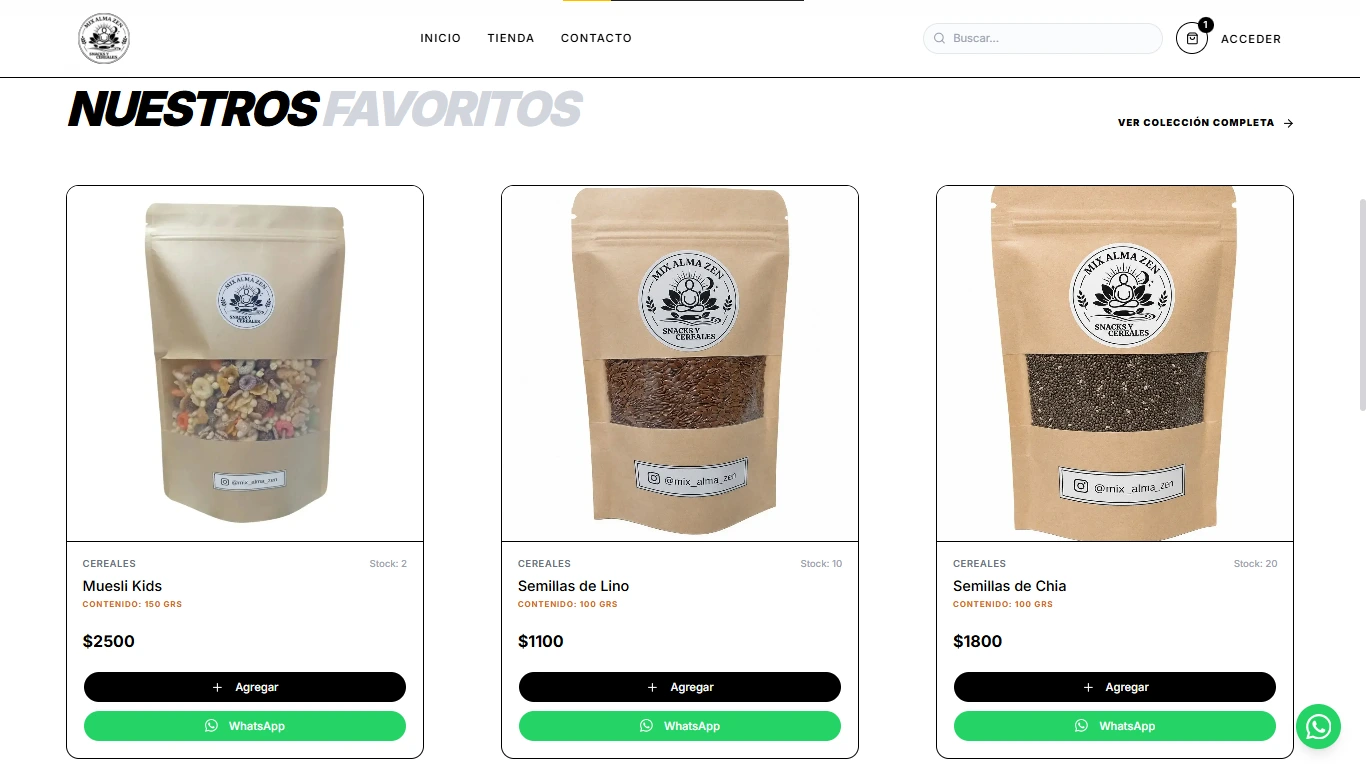
Mix Alma Zen
Online store for healthy snacks and cereals with WhatsApp orders and a self-managed panel for products, sales, orders, POS, expenses, and income.
Want to implement something similar?
Tell us about your project and we will reply with a clear proposal in under 24 hours.